Assessment of Irrigation Water Quality for Crop Production in Omi (Kampe) Irrigation Field, Yagba West Local Government Area, Kogi State, Nigeria

Authors

  • Muhammed Haruna Isah
    Confluence University of Science and Technology, Osara, Kogi State, Nigeria
  • Stephen Sunday
  • Tanko Dauda
  • Kombe Lucas Adang
  • Udoji Itodo Adams

Keywords:

Irrigation, Omi Dam, Salinity

Abstract

The Omi Dam irrigation area represents a significant agricultural opportunity in Kogi State, Nigeria. Crop production in this area is heavily reliant on water from Omi reservoir, during the dry season. The purpose of the research was to determine whether this irrigation water is suitable for use for crop production. Sampling was conducted monthly from three sites within the irrigation field from January 2025 to May 2025. A number of physicochemical properties were examined in the water samples, including pH (6.31-6.54), electrical conductivity (Ec) (87.66-105.06 µohms/cm), total dissolved solids (TDS) (73.0-55.20 mg/L), major cations such as sodium (Na+) (1.84-3.68 mg/L), potassium (K+) (4.34-5.17 mg/L), calcium (Ca2+) (2.22-3.70 mg/L) and magnesium (Mg2+) (1.97-2.37 mg/L), and major anions such as carbonate (CO3-) (50.62-97.62 mg/L), bicarbonate (HCO3-) (5.39-10.12 mg/L), phosphate (PO42-) (3.87-4.50 mg/L), sulphate (SO42-) (63.98-78.29 mg/l), chloride (Cl-) (58.14-69.76 mg/L) and nitrate (NO3-) (2.84-5.52 mg/L). The levels of the analyzed samples fall within the standards limits required for irrigation water rating except for phosphate. The water is considered chemically acceptable for irrigation based on the computed chemical index values with respect to SSP (53.73-65.45 %), SAR (1.14-2.72 meq/L), MAR (40.12-48.54 %), PI (61.31-74.08 %), KR (0.36-1.009), SCAR (1.05-2.87 meq/L) and ESP (1.64-3.80 meq/L) except for RSC (51.81-101.68 meq/L), RSBC (3.16-6.42 meq/L) and PS (87.52-92.11 meq/L). The Wilcox diagram suggests that every water samples is in good state. The irrigation water was classified as “low salinity” by the United States Salinity Laboratory diagram, making it appropriate for crop production.
Dimensions

Abdurraheem, M. I., Garba, T., Yahuza, Y. and Isyaku, B. M. (2020). Drainage Network Characteristics of Omi (Kampe) Dam Basin, Kogi State, Nigeria. IOSR Journal of Environmental Science, 14(4), 60–67. https://doi.org/10.9790/2402-1404016067

Abou El-Defan, T., El-Raies, S., El-Kholy, H. and Osman, A. (2016). A Summary of Water Suitability Criteria for Irrigation. Journal of Soil Sciences and Agricultural Engineering, 7(12), 981–989. https://doi.org/10.21608/jssae.2016.40540

Adegbola, G. A., Dauda, M., and Aluko, T. O. (2019). Assessment of the suitability of water quality for irrigation in Ogbomoso, Oyo State. GSC Biological and Pharmaceutical Sciences, 9(2), 021–031. https://doi.org/10.30574/gscbps.2019.9.2.0191

Adeniran, K. A., Amodu, M. F., Amodu, M. O. and Adeniji, F. A. (2010). Water requirements of some selected crops in Kampe dam irrigation project. Australian Journal of Agricultural Engineering, 1(4), 119–125.

Adeyemi, A. G., Temitope, S. L., Ogbor, O. B. and Babatunde, A. A. (2021). River Water Quality Assessment and its Suitability for Irrigation Purpose. FUDMA Journal of Sciences, 5(3), 413-419. DOI: https://doi.org/10.33003/fjs-2021-0503-770

Al-Aizari, H. S., Aslaou, F., Mohsen, O., Al-Aizari, A. R., Al-Odayni, A. B., Abduh, N. A. Y., … Taleb, E. A. B. O. (2024). Assessment of Groundwater Quality for Irrigation Purpose Using Irrigation Water Quality Index (Iwqi). Journal of Environmental Engineering and Landscape Management, 32(1), 1–11. https://doi.org/10.3846/jeelm.2024.20598

Anyango, G. W., Bhowmick, G. D. and Bhattacharya, N. S. (2024). A critical review of irrigation water quality index and water quality management practices in micro-irrigation for efficient policy making. Desalination and Water Treatment, 318(14), 100304. https://doi.org/10.1016/j.dwt.2024.100304

Ayers, R. S. and Westcot, D. W. (1985). Water Quality for Agriculture. FAO of the United Nations Rome, Italy.

Balachandar, D., Sundararaj, P., Rutharvel, M. K. and Kumaraswamy, K. (2010). An investigation of groundwater quality and its suitability to irrigated agriculture in Coimbatore, Tamil Nadu, India - A GIS Approach. International Journal of Environmental Science, 1(2), 176-190

Barathkumar, S., Sellamuthu, K. M., Sathiyabama, K., Malathi, P., Kumaraperumal, R., Devagi, P. and Pazhanivelan, S. (2025). Groundwater quality assessment in selected polluted hotspots of Tamil Nadu, India using geospatial and statistical approaches. Desalination and Water Treatment, 322, 101047. https://doi.org/10.1016/j.dwt.2025.101047

Chinasho, A., Bedadi, B., Lemma, T., Tana, T., Hordofa, T. and Elias, B. (2023). Quality assessment and evaluation of irrigation water and soil used for maize (Zea mays L.) production in Boloso Sore District, Southern Ethiopia. Heliyon, 9(6), e17299. https://doi.org/10.1016/j.heliyon.2023.e17299

Davis, Z., and Bush, E. (2025). Mitigating a Sodium Bicarbonate Water Source with Calcium and Magnesium to Produce Container-Grown Live Oak Trees. American Journal of Plant Sciences, 16(03), 332–343. https://doi.org/10.4236/ajps.2025.163026

Demo, A. H., Gemeda, M. K., Abdo, D. R., Guluma, T. N. and Adugna, D. B. (2025). Impact of soil salinity, sodicity, and irrigation water salinity on crop production and coping mechanism in areas of dryland farming. Agrosystems, Geosciences and Environment, 8(1), 1–22. https://doi.org/10.1002/agg2.70072

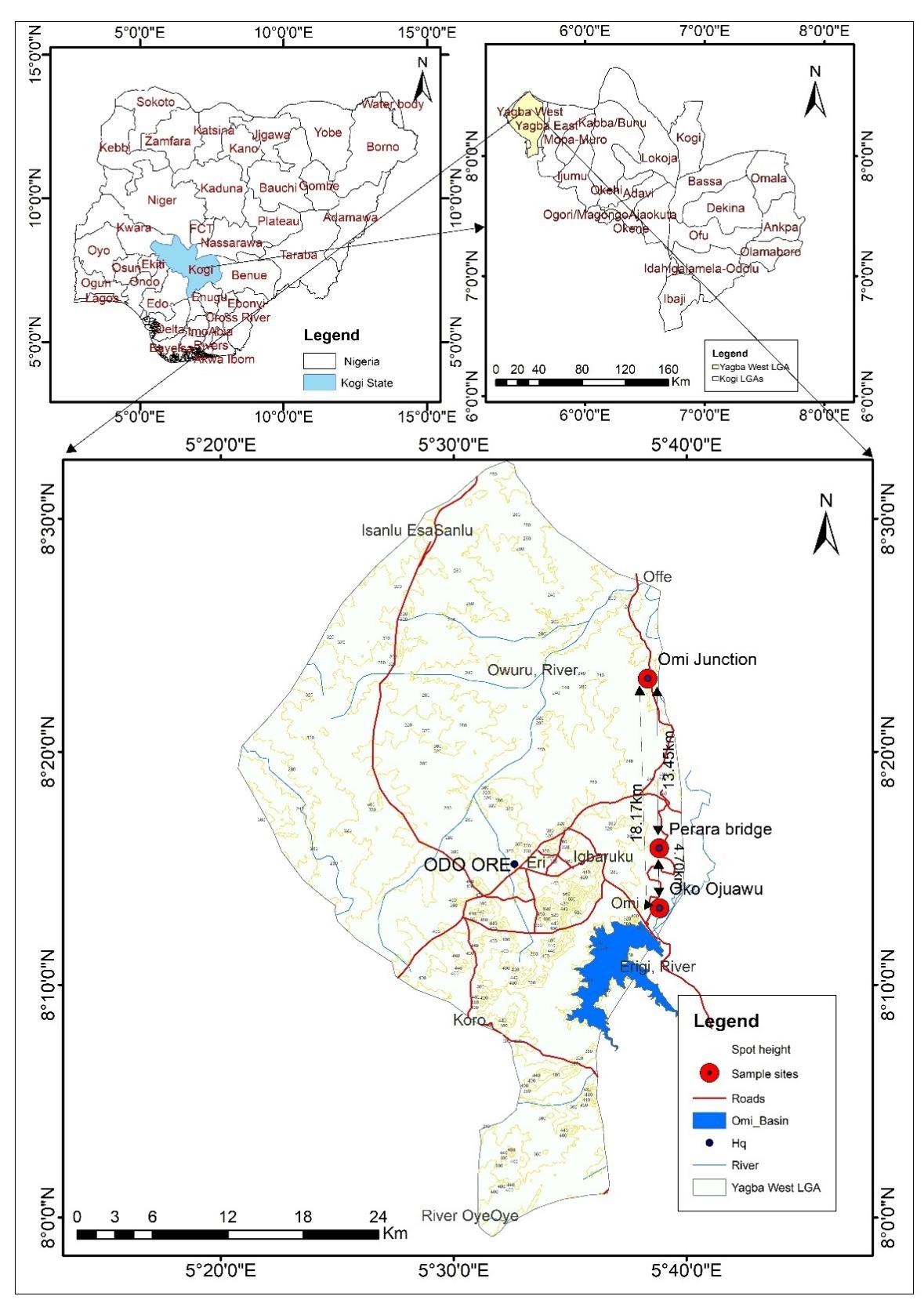
Study Area

Published

07-12-2025

How to Cite

Isah, M. H., Sunday, S., Adang, K. L., & Adams, U. I. (2025). Assessment of Irrigation Water Quality for Crop Production in Omi (Kampe) Irrigation Field, Yagba West Local Government Area, Kogi State, Nigeria (T. Dauda, Trans.). FUDMA JOURNAL OF SCIENCES, 9(12), 338-344. https://doi.org/10.33003/fjs-2025-0912-4285

How to Cite

Isah, M. H., Sunday, S., Adang, K. L., & Adams, U. I. (2025). Assessment of Irrigation Water Quality for Crop Production in Omi (Kampe) Irrigation Field, Yagba West Local Government Area, Kogi State, Nigeria (T. Dauda, Trans.). FUDMA JOURNAL OF SCIENCES, 9(12), 338-344. https://doi.org/10.33003/fjs-2025-0912-4285

Most read articles by the same author(s)